UN Office for Disarmament Affairs (UNODA) and Regional Disarmament Centres
April 30, 2021.
UN Office for Disarmament Affairs (UNODA)
The UNODA’s mandate on regional disarmament is to promote and enhance international efforts towards global disarmament and international peace and security through the support and promotion of regional disarmament efforts and initiatives using approaches freely arrived at among the States of the region and taking into account the legitimate requirements of States for self-defence and the specific characteristics of each region (A/66/6(Sect.4)) UNODA works to promote regional disarmament, taking into account the specific characteristics of each region and in accordance with the principle of undiminished security at the lowest level of armaments, in order to enhance the security of all States and to thus contribute to international peace and security by reducing the risk of regional conflicts (PP 9 of A/RES/65/45).
- The UN Regional Centre for Peace, Disarmament and Development in Latin America and the Caribbean (UNLIREC, located in Lima, Peru),
- The UN Regional Centre for Peace and Disarmament in Asia and the Pacific (UNRCPD, located in Kathmandu, Nepal),
- The UN Regional Centre for Peace and Disarmament in Africa (UNREC, located in Lomé, Togo)


Small Arms and Light Weapons and Gender Mainstreaming
IANSA is the implementing partner of a 3 year project by the UNODA, funded by the European Union, titled “Civil society engagement in support of the gender mainstreamed policies, programmes and actions in the fight against small arms trafficking and misuse, in line with the Women, Peace and Security agenda.” The primary objective of the project is to strengthen civil society engagement on gender-mainstreaming small arms control by addressing the connection between gender specific approaches and impacts, women’s rights, small arms control and armed violence at the local and community level.
The project aims to:
- Contribute to international peace, security, gender equality and sustainable development by enhancing the effectiveness of small arms control measures through the promotion of approaches based on systematic gender analysis, the integration of gender perspectives and women’s empowerment initiatives;
- Support the implementation of the gender-relevant outcomes of the 2018 Third United Nations Conference to review progress made in the implementation of the Programme of Action (UNPoA);
- Contribute to the broader International policy agenda on gender equality and women’s empowerment in line with the Women, Peace and Security Agenda and 2030 Agenda for Sustainable Development.
One action of the project is to lead in-country training programmes in order to promote and support initiatives about gender perspectives, small arms and light weapons control, and disarmament. UNODA through its Regional Disarmament Centres facilitate these programmes in collaboration with national commissions on small arms and/or governments. Visit the official UNODA webpage with all information on the gender and SALW project here.
UNREC has organised 4 in-country training programmes in:
- the Central African Republic (13-14 October 2020) with participation from IANSA members: Global Peace Chain-CAR and Réseau de Femmes pour la Protection et l’Action Sociale (RFPAS);
- the Democratic Republic of Congo (23-25 November 2020) with participation from IANSA members: Living Peace Institute, MenEngage Alliance-DRC, and Vision Gram International;
- Cameroon (31 May to 3 June 2021) with participation from IANSA members: WILPF-Cameroon and CAMYOSFOP;
- Mali (from 6-8 September 2021) with participation from IANSA members: MenEngage Alliance Mali, CONASCIPAL, and Association des Femmes pour les Initiatives de Paix (AFIP).
- Sierra Leone (from 30 November – 3 December) with participation from IANSA member: the Sierra Leone Action Network on Small Arms (SLANSA). The other civil society organisations that contributed presentations: Handicap International Sierra Leone, MenEngage Alliance Sierra Leone and the Women’s Forum.
UNRCPD has adapted the in-country training programme to hybrid/in-person format and webinar events in:
- Cambodia (webinars held on 8, 9, 19 and 20 July 2021);
- Lao PDR (hybrid training in Vientiane from 14 to 16 July 2021);
- Papua New Guinea (webinars held on 23, 24, 30 September and 1 October 2021)
- In addition, UNRCPD organized a series of regional virtual events and training on broader issues, such as gun violence and illicit small arms trafficking from a gender perspective and national reports on the UN Programme of Action on SALW:
- A webinar on the convergence between the SALW agenda and the Women, Peace and Security National Action Plan in Timor-Leste, with key government officials (5 February 2021)
- A stock taking webinar on the series of events “Gun Violence and Illicit Small-Arms Trafficking from a Gender Perspective” (8 March 2021) Read UNODA’s article here.
- Virtual training on UN PoA national reports for government officials in Bangladesh, Cambodia, Lao PDR, Nepal, Papua New Guinea, the Philippines, Solomon Islands and Timor-Leste (28 May 2021).
Learn more about the in-country training programmes by reading the UNODA articles below:
UNODA
(July 7th, 2021) “UNODA concludes training series on gender and small arms control”
“In preparation of the Seventh Biennial Meeting of States on the United Nations Programme of Action of Small Arms (BMS7) and the Seventh Conference of States Parties to the Arms Trade Treaty (CSP7), the United Nations Office for Disarmament Affairs (UNODA) hosted five live webinars for staff members from regional and sub-regional organizations to learn about the role of gender in relation to small arms control.
From 17 May until 8 June 2021, the training series provided a space for representatives of regional and sub-regional organizations in Africa, Asia-Pacific, Europe, and Latin America and the Caribbean to exchange on their work and activities to ensure that gender considerations are implemented across policies, programmes, and actions in the fight against small arms trafficking and misuse, in accordance with the Women, Peace and Security (WPS) agenda.”
UNREC
“From 30 November to 3 December 2021, the United Nations Regional Centre for Peace and Disarmament in Africa (UNREC) partnered with the Sierra Leone National Commission on Small Arms and Light Weapons (SLeNCSA) and the Mines Advisory Group International (MAG) to conduct a series of capacity-building activities aimed at ensuring that gender considerations are systematically integrated in small arms control policies and programmes in Sierra Leone.”
UNREC worked with Mali’s National Commission to Combat the Proliferation of small arms and light weapons to organize an in-country training programme in Bamako on gender mainstreaming arms control in the fight against the proliferation and illicit circulation of small arms and light weapons.
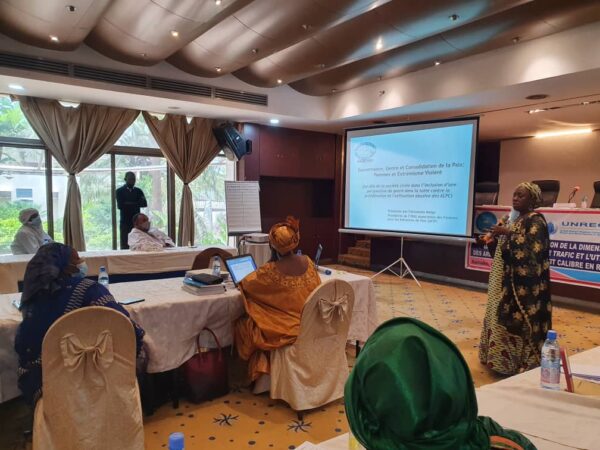

“From 31 May to 3 June 2021, UNREC conducted a training for 45 governmental and civil society representatives on the topic of gender and small arms control in Yaoundé, Cameroon. This was the third in a series of trainings as part of a global project in support of gender mainstreaming policies, programmes and actions in the fight against small arms trafficking and misuse, in line with the Women, Peace and Security agenda, funded by the European Union.”


UNRCPD
“From 14 to 16 July, the United Nations Regional Centre for Peace and Disarmament in Asia and the Pacific (UNRCPD), in partnership with the Ministry of Foreign Affairs of the Lao PDR, conducted a training on mainstreaming gender into small-arms related policy, programmes and legislation. Held in hybrid format, the course drew thirty-two government officials from various departments and agencies, who gained in-depth and practical knowledge about how gender plays a role in small arms and light weapons (SALW) control, and ways to apply global instruments and agendas to combat the illicit trafficking, use and misuse of these weapons.”
“UNRCPD concluded a series of webinars on gender and small arms control for government officials in Cambodia. As the COVID-19 restrictions to travel in Asia-Pacific persist, UNRCPD provided the training in virtual format rather than in-country as originally planned.”
“On 28 May 2021, the United Nations Regional Centre for Peace and Disarmament in Asia and the Pacific (UNRCPD) conducted an online training on national reporting on the UN Programme of Action on small arms (UN PoA) for government officials from eight Member States in Asia and the Pacific, in preparation for the upcoming Seventh Biennial Meeting of States (BMS7).
The training, which provided a detailed run through of the reporting template by UN experts, drew nearly 50 government officials from Bangladesh, Cambodia, Lao PDR, Nepal, Papua New Guinea, the Philippines, Solomon Islands and Timor-Leste – all countries that are yet to submit their national report for the implementation period 2018-2019.”
“On 8 March, parliamentarians and civil society actors across Asia and the Pacific marked International Women’s Day with a workshop on the results, challenges and opportunities of a multi-year project tackling how illicit small arms and light weapons (SALW) impact people differently based on their gender. The virtual meeting followed on from a series of workshops held in Asia and the Pacific between 2018 and 2020.
The virtual event on “Gun Violence and Illicit Small-Arms Trafficking from a Gender Perspective” brought together small arms and light weapons control experts to interact with parliamentarians as well as civil society organizations from 12 countries of the region: Afghanistan, Bhutan, Cambodia, Fiji, India, Lao People’s Democratic Republic, Nepal, New Zealand, Pakistan, the Philippines, Sri Lanka and Timor-Leste. The exchange was co-organized by the United Nations Regional Centre for Peace and Disarmament in Asia and the Pacific (UNRCPD) and the International Action Network on Small Arms (IANSA) in the framework of the global project on gender and small arms and light weapons, funded by the European Union (EU).”